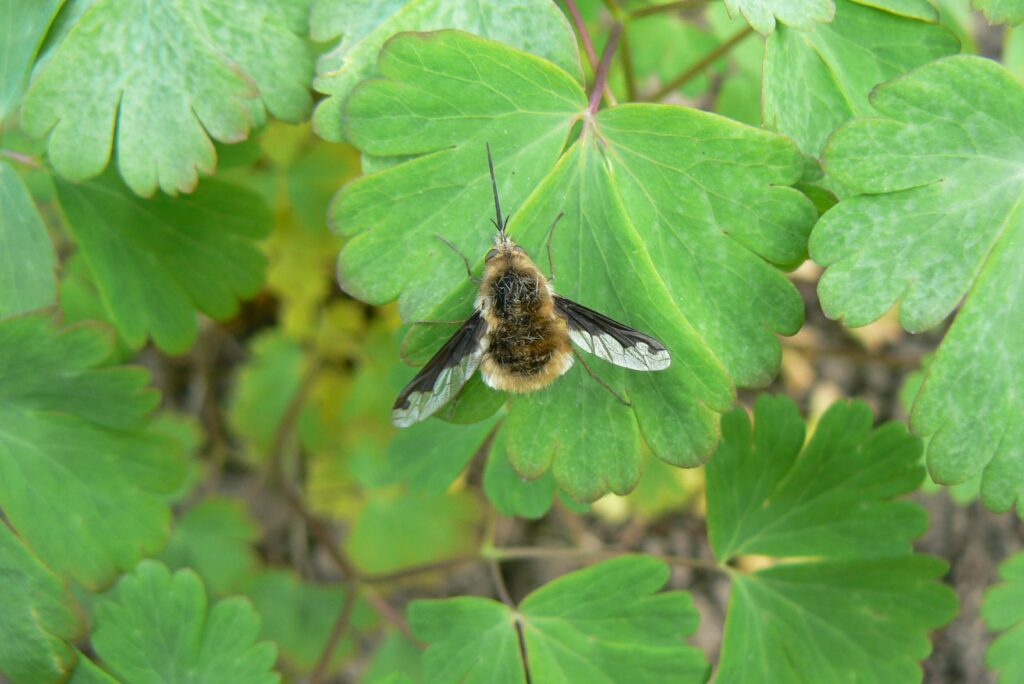
A record-breaking sighting of the Dark-edged Bee-fly (Bombylius major) was sighted earlier this month, feeding on some snowdrops. This record, made in East Lothian by Ellen Wilson (a TWIC recorder) marks the earliest record of this species in all of Scotland by almost two weeks!
Ellen told TWIC:
“On the 3rd March we had really warm sunshine…a large patch of Snowdrops was smothered in very active honey bees, so their buzzing was very audible. Almost as soon as I was bending down to look among them for anything else of interest the bee-fly arrived and was zooming between Snowdrops and bare (leaf covered) patches.”
This fluffy little mimic is often mistaken for the bees it parasitises – by humans as well as other animals, which likely offers it some protection against predation. Unlike bees however, the bee-fly has a very noticeable and long proboscis aka ‘tongue’ which is used to probe flowers for nectar.
As adults these flies are pollinators that feed exclusively on nectar, but as larvae they’re carnivorous parasites of solitary mining bees and wasps. Female Dark-edged Bee-flies will seek out burrows created by these species and lay their eggs near the entrance. Or occasionally on flowers frequently visited by the host species in hopes an adult will pick up the larvae along with pollen on their next visit. After pupating in the host’s burrow over winter, the new adult bee-flies will emerge in spring, ready to start the cycle again.
Despite their somewhat grisly child-rearing tactics, adult Dark-edged Bee-flies are important pollinators that are often overlooked. They act as generalist pollinators, meaning they visit a wide range of species, including flowers that may not attract many – if any – other pollinator species, e.g. Lungwort. Dark-edged Bee-flies are considered ‘dominant’ pollinators – sometimes pollinating up to two thirds of their ‘local’ flowers!
The Dark-edged Bee-fly is one of four species of beefly in the UK, although this species is our most familiar beefly and the only one currently extant in Scotland. Historically the species has been underreported. Since 2016 the British Soldierflies and Allies group have been running Bee-fly Watch, a recording scheme dedicated to encouraging people to look out for and report these fluffy little flies.
Keep an eye out as the weather continues to warm up and see if you can spot a Dark-edged Bee-fly hovering around the spring flowers. Records can be submitted via iRecord website or app. A handy ID sheet is also available here (PDF) and there is further information on how to recognise bee-flies on the scheme website.