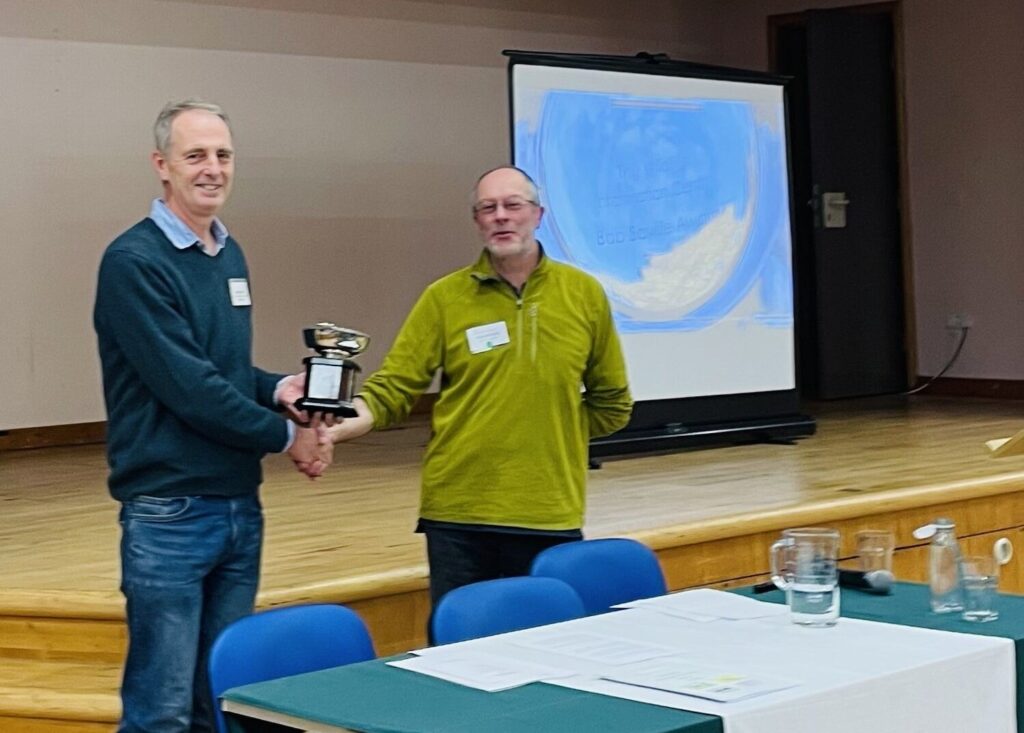
The 2025 Bob Saville Award was presented to Mark Cubitt at the TWIC Conference on Saturday 15 November 2025 at the Port Seton Centre. The prize is awarded annually by TWIC to someone who has made an outstanding contribution to biological recording in the TWIC area. It commemorates the late Bob Saville, a key member of The Wildlife Information Centre team for many years and one of the best-known faces in biological recording in Scotland. The award (a silver quaich) was presented by TWIC Director, Michael Scott to Mark at the event.
Mark has had a lifelong interest in natural history and wildlife recording and has a long association with TWIC, primarily in his role as a county moth recorder. He started recording moths in 2007, and since then, has made an enormous contribution both nationally and within the TWIC area. He is now county moth recorder for all three Lothian vice counties.
Always helpful with verifying records for TWIC, Mark was also an early adopter of iRecord for verifying sightings and providing timely feedback to recorders. He has been an expert volunteer on the West Lothian Council Local Biodiversity Sites Steering group for many years, contributing to discussions and surveying sites. He also helps with habitat management and makes moth traps to loan to new recorders. In 19 years of trapping he has set light traps on 1,581 nights and added well over 50,000 moth records to the National Moth Recording Scheme. The TWIC database currently holds more than 45,000 moth records with Mark as named recorder.
In addition to his county moth recorder work, Mark has created and maintains several resources invaluable to the mothing community. With Roy Leverton, Mark co-authored the The Larger Moths of Scotland book in 2024 – the first book specifically on moths in Scotland and full of knowledge. Mark is also a key person behind the East Scotland Butterfly Conservation website, writing and maintaining content, most notably the online maps. He also maintains the Scottish Moth Voucher archive and has recently created an app to help identify micromoths anywhere in the UK; this app is now freely available on the British Entomological & Natural History Society (BENHS) website.
Fellow moth recorder, Katty Baird, recalls how Mark’s moth knowledge ‘wowed the crowd’ during one memorable Bioblitz event, as he presented pots of moths – and was able to name them all – after having camped out with his trap on the dunes overnight. Mark’s enthusiasm has also clearly rubbed off on Katty and other local recorders with Katty detailing ‘ridiculously ambitious’ plans to lug moth traps off-piste into the wilds in search of an unlikely species and countless adventures underground in search of Herald and Tissue moths as part of the Hibernating Heralds project. Undeniably though, these exploits have paid off with new discoveries being made and Mark being noted with several firsts for Scotland, including Dingy Footman (Eilema griseola), Twin-Spotted Wainscot (Lenisa geminipuncta), Waved Black (Parascotia fuliginaria) and the micro-moth, Harpella forficella.
In addition to moth recording, Mark also currently leads the Lothian Ringing Group Seabird steering group, organising trips out to the Forth islands where they ring 500-1000 birds each year and is also part of BTO’s Seabird Monitoring Programme, training young ringers wanting to get into seabird research.
Clearly, Mark has made a tremendous contribution, both by adding directly to our knowledge about moths and their conservation and by providing information and tools that assist others in their recording. He is a very worthy winner of the 2025 Bob Saville Award.
With thanks to Katty Baird for her significant contribution to this article.